


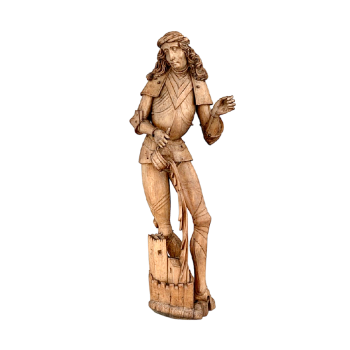
Wooden statue of St. Florian
This is a wooden statue of Saint Florian. St. Florian is a Catholic saint. He is honored as the chief saint of firefighters, chimney cleaners and winemakers. He is also regarded as the chief guarantor against fires and floods. The statue depicts St. Florian as an image of a Roman soldier. He usually holds a bucket or basin, symbolizing his role in dousing flames and protecting people from fire hazards. Legend has it that in the 4th century AD, St. Florian used a bucket of water to put out a fire and save a city, which made him the patron saint of firefighters.
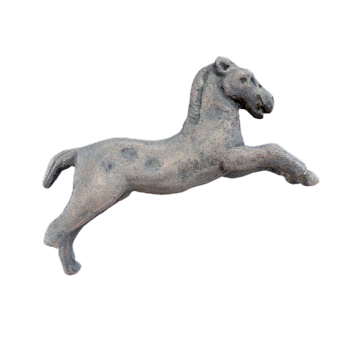
Ancient Roman bronze horse sculpture
This is an ancient Roman bronze horse sculpture in the collection of the Evora Museum. This work can be traced back to the ancient Roman Empire, about the 1st to 3rd centuries AD. The statue was found at a Roman site in Évora, Portugal, and is currently in the collection of the local Évora Museum. The sculpture captures the dynamic moment of the horse's leap, with its front legs off the ground and its hind legs bent and firmly supported on the ground, demonstrating the Roman artist's superb realistic skills and in-depth understanding of animal anatomy.

A bust of the Roman emperor Marco Areliu
This bust depicts the last emperor of the five sages of the ancient Roman Empire, the famous "philosopher emperor"-Marco Aurelius, who reigned from 161 to 180 AD and was one of the most respected emperors in Roman history. The statue displays his signature thick curly hair and curly beard, a fashion style pioneered by Emperor Hadrian and inherited by subsequent Emperors of the Antunen dynasty, designed to mimic the image of the Greek philosopher. He was a Stoic philosopher whose Meditations are still an important philosophical document.

3D model of griffin with animation
It is a mysterious creature derived from ancient myths and legends, combining the body of a lion with the head, wings, and front paws of an eagle. It is usually depicted as possessing the strong body of a lion and the sharp gaze of an eagle, a combination of strength and wisdom. In ancient Greek and Roman mythology, the griffin was a symbol of wealth and power, often carved on temples and coins as the incarnation of a guardian deity. It is considered a creature that guards treasures and treasures, and also symbolizes the divine guardian. It was also very popular in medieval heraldry, often used by nobles and knights as part of their family crest to showcase their nobility and bravery.
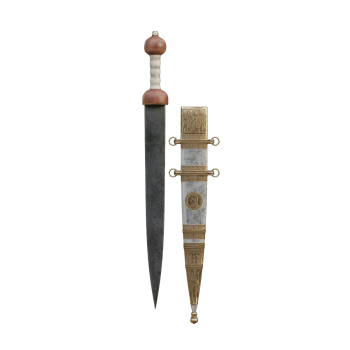
The Sword of Tiberius in Ancient Rome
It is a famous ancient Roman sword and its scabbard, discovered near the Rhine River in Mainz, Germany. Since 1866, it has been a collection of the British Museum, donated to the museum by philanthropist Felix Slade. This sword is made of iron, and its scabbard is made of bronze plated with tin and gold. The decoration on the scabbard depicts the scene of Tiberius ceding military victory to Augustus after a successful Alpine campaign. Augustus, half naked, sat in Jupiter's seat, flanked by the Roman goddess of victory and the god of Mars Urtor, while Tiberius, dressed in military uniform, presented a small statue of the goddess of victory to Augustus.

Rome during the reign of Constantine I
A fine plaster model depicting the Roman Empire during the reign of Constantine I in the 4th century AD. This model is now located in the Museum of Roman Civilization, which opened in the 1930s to showcase the history of ancient Rome.

Roman vase
They are common ceramic containers in ancient Roman civilization, not only daily necessities, but also symbols of art and culture. These vases are usually made of clay and fired at high temperatures, possessing strong and durable characteristics. The design of Roman vases is diverse, ranging from simple practical shapes to complex decorative shapes, reflecting the aesthetic taste and craftsmanship level of Roman society. Decorative patterns may include mythological scenes, historical events, geometric shapes, or plant patterns, which are not only aesthetically pleasing but also convey the religious beliefs and social values of the time. Some Roman vases are used to store liquids, while others are used for decoration or as burial objects at funerals.

Harrogate Museum Roman period bizarre faces oil lamp
Named after its bizarre face design, it features a handle with a loop at the top and a small ring below. The central opening is semi-circular, resembling a face shaped mouth, surrounded by decorations representing beards, and each endpoint has a ring. It has three nozzles and a seal with a Greek inscription on the base. It can be traced back to the Greco Roman period. It was once part of the Kent Collection and was bequeathed to the Harrogate Museum in 1968. Items from Gaza. Not only did it meet the practical needs of ancient people, but it also demonstrated the cultural characteristics of the time in terms of artistry and decoration.

The statue of Vesta, the female hearth god in Roman mythology
Vesta was the virgin goddess in Roman religion who was in charge of the hearth, home, and household. She is rarely depicted in human form and is often personified by the fire of her temple in the Roman Forum. Only her priestess Vesta was allowed to enter her temple, and they guarded the sacred flame by the fireplace in her temple.

Marble statues of the gods Mars and Venus
This statue is made of marble, standing 1.73 meters (5 feet 8 inches) tall, and was crafted between 120-140 AD (with repairs made around 170-175 AD). The male figure originally represented the ancient Roman Emperor Hadrian, but his head was later restored to Lucius Verus. The female image represents his wife Sabina. This statue is currently located in the Louvre Museum in Paris, France.

The Victory Parade after the Battle of Aktime
This marble relief was part of a triumphal parade in Rome to commemorate Octavian's victory at the Battle of Aktim. The Battle of Aktia, a naval battle between the Roman Republic and the Ptolemaic dynasty of Egypt, took place on September 2, 31 BC, and was the last major battle in the Roman Civil War. Roman Commander Agrippa led 400 warships and fought Antony's 500 warships on the west coast of Greece. As a result, Antony's fleet was almost wiped out. The naval battle became the decisive battle of Antony's struggle against Octavian.

Statue of the Roman Emperor Tulazhen
Trajan (Traianus, Marcus Ulpius Nerva, September 18, 53-August 9, 117), the second emperor of the ancient Roman Antony dynasty and one of the five Roman emperors, reigned from 98 to 117. During his reign, he consolidated the economic and social system internally, launched wars with foreign countries, made outstanding military achievements, expanded the territory of the Roman Empire to the largest extent in history, and established the "Thuragin column" to record his achievements.

Old Roman style solid wood cabinet

Popular Models
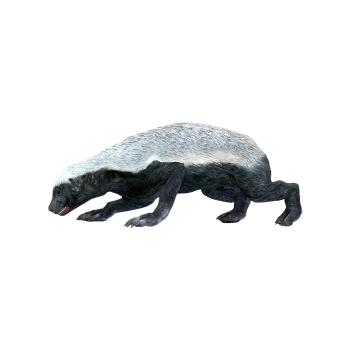
Honey Badger (3D animated model)
192 View
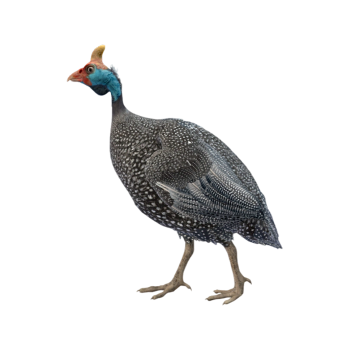
Guinea fowl (3D animated model)
163 View
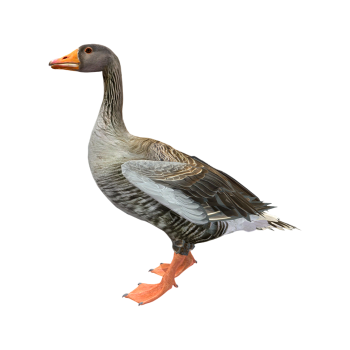
Wild Goose (3D animated model)
185 View

Red Fox (3D animated model)
153 View
Random Model
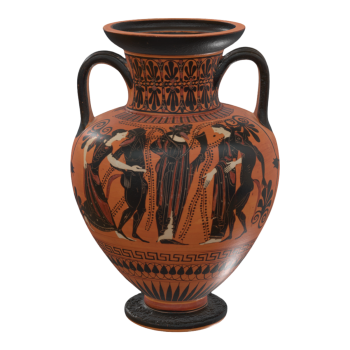

3D animation of rooster model
904 View


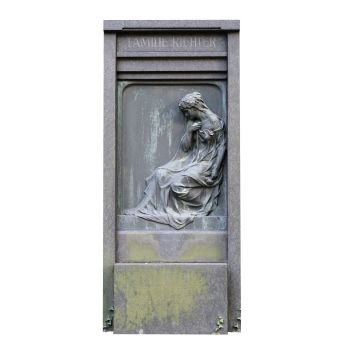
Richter Family Tombstone
845 View


Milwaukee M12 electric drill
1285 View

BMW M4 2021 Competition Edition
785 View

Statue of Warrior in Helmet
883 View